

Scripts are comforting. They reduce anxiety, keep messaging consistent, and help new reps get through a call without freezing.
But scripts can also be a quiet performance killer. The moment a buyer goes off script (which is most moments), a rigid talk track can turn a capable salesperson or service agent into a robot reading lines, missing cues, and losing trust.
The real question is not “talk tracks vs roleplay, which is better?” It is when do scripts help, and when do they hurt, and how do you combine both to build real skill?
What “talk tracks” and “roleplay” actually train
Talk tracks (scripts) train recall and consistency
A talk track is a prebuilt set of words, phrases, and flows used for common situations, for example opening a discovery call, explaining value, or handling a known objection.
Talk tracks are great at: - Standardizing messaging across a team - Giving new hires a starting point - Reducing “blank page” anxiety - Supporting compliance or brand requirements
They are not inherently bad. The problem is confusing recall with competence.
Roleplay trains judgement and adaptability
Roleplay (live or AI-based) puts a person in a simulated conversation where they must: - Listen - Decide what to say next - Respond to emotion and ambiguity - Recover when something goes wrong
In other words, roleplay trains what real calls demand: contextual decision-making.
If talk tracks are the sheet music, roleplay is rehearsal with a band that does not always play the same tempo.
Talk tracks vs roleplay: a practical comparison
| Dimension | Talk tracks (scripts) | Roleplay (practice conversations) |
|---|---|---|
| Best at | Consistency, onboarding, messaging alignment | Skill transfer, adaptability, handling curveballs |
| What it builds | Recall, confidence to start | Judgement, fluency, resilience |
| Common failure mode | Robotic delivery, poor listening, “script shock” when things change | Poor facilitation, inconsistent feedback, awkwardness if culture is unsafe |
| Ideal usage | High-frequency, predictable moments | Objections, negotiation, discovery depth, emotion, multi-step problem solving |
| How to measure | Adoption, message accuracy | Talk-to-listen ratio, objection handling success, sentiment, next-step conversion (in simulation and in real calls) |
When talk tracks help (and why)
Talk tracks are most valuable when the conversation has repeatable structure and the risk of inconsistency is high.
1) Early ramp for new hires
New reps and agents are managing cognitive load. They are learning the product, the CRM, the buyer journey, and basic call flow all at once.
A talk track acts like training wheels. It helps them get moving.
What to watch for: if someone is still reading word-for-word after they have basic competence, the talk track is now limiting growth.
2) Brand, compliance, or safety-critical language
Some industries and scenarios require careful phrasing (regulated statements, privacy notices, safety procedures, refunds policy explanations).
Here, a talk track is not just a performance tool, it is risk control.
3) High-frequency moments that should be consistent
Examples: - Greeting and agenda setting - “Why we are calling” clarity - Setting expectations for next steps - Confirming understanding
These moments benefit from consistency because they set the container for the rest of the call.
4) Creating a shared “language” for coaching
A good talk track can become a coaching reference point. Managers can say, “Your opener skipped the problem framing,” and everyone knows what that means.
This matters because teams often fail not from lack of effort, but from lack of shared definitions.
When talk tracks hurt (and what it looks like on calls)
Talk tracks start hurting when they become the goal instead of a guide.
1) When buyers introduce ambiguity
Real prospects do not respond in neat boxes. They jump around. They challenge assumptions. They bring politics, budget constraints, and previous vendor baggage.
A rep who is “script-dependent” often: - Forces the conversation back to the script - Asks irrelevant questions because the playbook says so - Misses buying signals while searching for the next line
2) When trust is built through listening, not perfect wording
In sales and customer service, people can tell when you are reciting. Over-polished delivery often signals “I am not actually hearing you.”
If your team is getting feedback like “pushy,” “generic,” “didn’t understand our situation,” the root cause is often over-scripting.
3) When the objection is emotional, political, or identity-based
Not all objections are logical. “We are happy with our current provider” might mean “I do not want change risk.”
Scripts tend to answer the literal words, not the underlying concern.
4) When reps optimize for compliance with the script, not outcomes
This is subtle. If coaching scorecards reward “said the line” more than “earned the next step,” you can accidentally train performative behavior.
Roleplay: why it works, and why it fails in many companies
Roleplay works because it creates practice under pressure, but most organizations struggle with it for predictable reasons.
Why roleplay works
Roleplay creates repetition with variation. That is how people build conversational fluency.
Done well, it: - Builds confidence without risking real deals - Improves objection handling speed and quality - Helps reps recover from mistakes (a key skill) - Makes coaching observable, not theoretical
Why roleplay fails (common pitfalls)
Roleplay often becomes ineffective when: - Scenarios are unrealistic, for example cartoonishly hostile buyers - Feedback is vague (“be more confident”) - Participation feels unsafe or embarrassing - Practice is too infrequent to create real change
The fix is not “stop roleplaying.” The fix is better scenarios, better feedback, and more consistency.
The best approach: scripts as scaffolding, roleplay as the gym
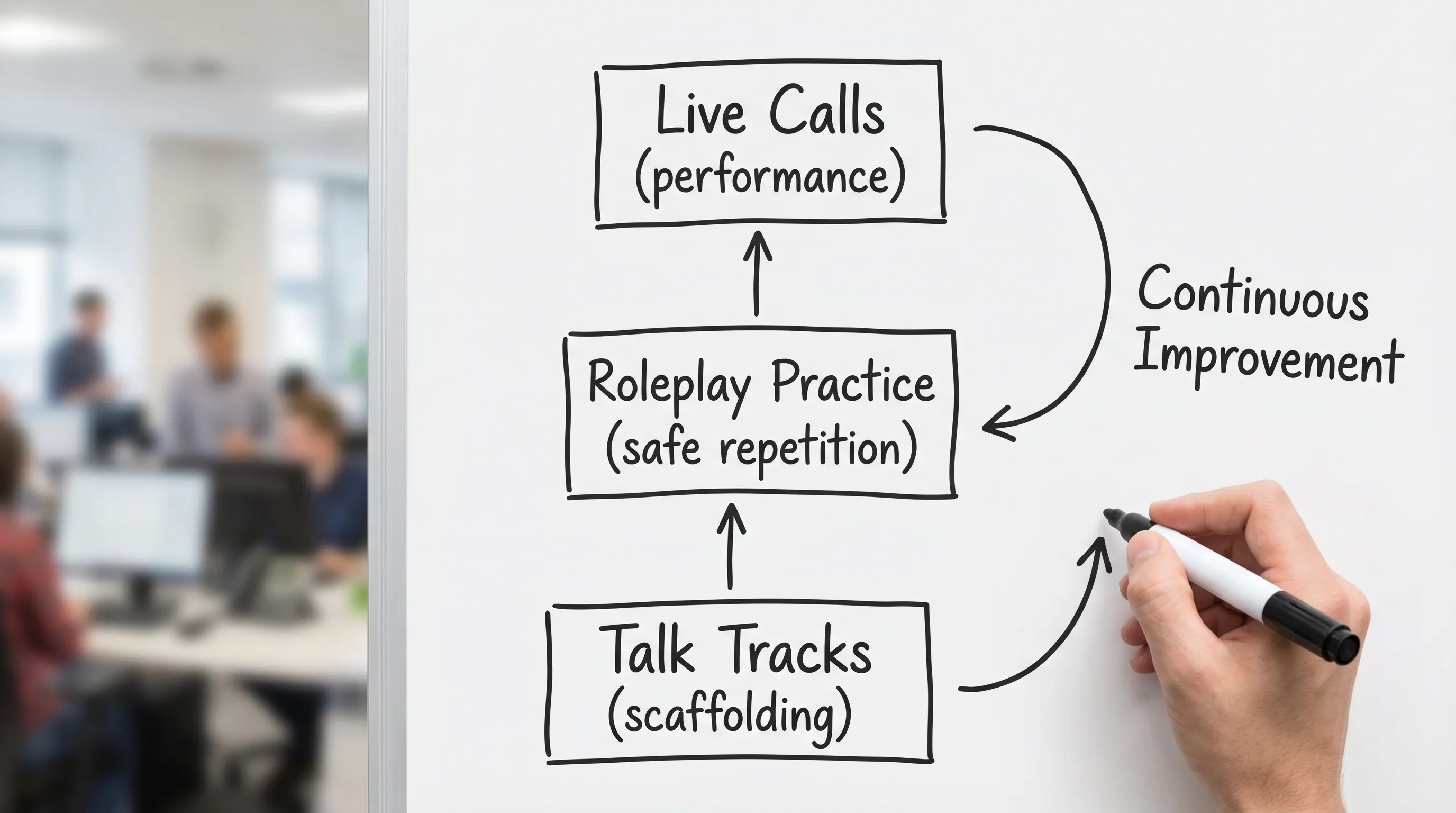
High-performing teams treat talk tracks as scaffolding, then intentionally remove the scaffolding through practice.
A practical blended model looks like this:
1) Create “modular” talk tracks, not word-for-word scripts
Instead of forcing exact phrasing, define: - The goal of each segment - A few example lines that feel natural - “Must hit” points (especially for compliance)
Example (discovery transition module):
Goal: Earn permission to ask deeper questions.
Good options: - “To make sure I’m not guessing, can I ask a few questions about how you handle X today?” - “Before I recommend anything, I want to understand what success looks like on your side.”
Must hit: Confirm time and agenda, confirm what prompted the conversation.
This approach protects outcomes while allowing personality.
2) Roleplay the moments where scripts break
Roleplay should focus on: - Interruptions - Pushback - Unexpected constraints - Emotional escalation - Competitive comparisons
In other words, practice the parts of the call where “perfect messaging” is less important than good judgement.
3) Add a clear scoring rubric (so feedback is actionable)
Avoid generic coaching. Score what matters.
A simple rubric might include: - Clarity (did they set a crisp next step?) - Discovery depth (did they uncover constraints and criteria?) - Objection handling (did they address root cause and confirm?) - Empathy and listening (did they reflect and validate?)
4) Close the loop with real data
Talk tracks and roleplay should be tied to outcomes: - Conversion to next meeting - Deal stage progression - Time to resolution (service) - Customer satisfaction signals
When training is connected to metrics, it becomes operational, not optional.
Where AI roleplay fits (and why it is changing training in 2026)
Traditional roleplay depends on managers and peers, which creates three bottlenecks: time, consistency, and quality of feedback.
AI roleplay training can remove those bottlenecks by giving every rep and agent: - More reps (practice volume) - More variation (realistic curveballs) - More consistency (standardized scenarios) - Faster feedback (immediate, specific coaching)
This is where an AI training platform like Scenario IQ fits naturally into a blended model.
Use AI roleplay to turn talk tracks into real skill
A strong workflow is:
Talk track introduced (what to say and why) then AI simulation (apply it under pressure) then real-time feedback (what worked, what didn’t) then repeat with adaptive difficulty (harder objections, different personas).
Scenario IQ is designed around that loop with: - AI-powered roleplay simulations for sales and service conversations - Personalised training scenarios aligned to your team’s needs - Real-time feedback to reduce “I don’t know how I did” ambiguity - Progress tracking analytics and performance metric dashboards for visibility - Adaptive feedback and guidance and customisable skill levels, so beginners and top performers both grow - Team-focused learning for consistent standards - Enterprise-grade security for organizational use
(If you are evaluating tools, the key question to ask is whether the platform gives feedback that is specific enough to coach, and whether analytics connect practice to performance.)
Choosing the right mix: a quick decision guide
Use talk tracks when: - The moment is predictable and repeatable - Consistency matters more than creativity - The rep is new or the process is new - Compliance or brand risk exists
Prioritize roleplay when: - Objections vary widely - The buyer needs to feel heard - The rep must diagnose before prescribing - The team needs to improve adaptability, not memorization
If you are seeing robotic calls, low discovery quality, or reps who “fall apart” when interrupted, you probably need less scripting and more practice.
Frequently Asked Questions
Are talk tracks the same as scripts? Talk tracks are often lighter than scripts. A good talk track focuses on intent, structure, and a few example phrases, not a word-for-word recital.
How often should sales or service teams roleplay? Enough to create repetition. For most teams, short sessions multiple times per week beat a long monthly roleplay that people dread and forget.
Can AI roleplay replace manager coaching? Not fully. AI can scale practice and provide consistent feedback, but managers still coach priorities, deal strategy, and real-world nuance. The best results come from combining both.
How do you prevent roleplay from feeling awkward or punitive? Make scenarios realistic, normalize mistakes as part of practice, and score observable behaviors. Psychological safety matters as much as the scenario design.
What should you measure to know training is working? Track leading indicators (simulation scores, discovery depth, objection handling quality) and business outcomes (next-step conversion, pipeline progression, time to resolution, customer satisfaction signals).
Build talk tracks that sound human, and skills that hold up under pressure
If your team relies on scripts to feel confident, you are not alone. The fastest path to real performance is turning those talk tracks into adaptable skills through consistent practice.
Scenario IQ helps teams do that with AI-powered roleplay simulations, personalised scenarios, real-time feedback, and analytics that make progress visible. Explore the platform at Scenario IQ and see how AI roleplay can strengthen sales and service conversations without creating scripted, robotic delivery.